

Carrier Liability vs. Freight Insurance: What’s the Difference?
Freight damage and loss are a reality of shipping. It’s not a matter of if it will happen to you; it’s a matter of when. When damage or loss occurs, your first thought is often, “how will I be compensated?” To answer the question, you need to understand the difference between carrier liability and freight insurance.
Carrier Liability
Every freight shipment is covered by some form of
liability coverage, determined by the carrier. The amount of coverage is based on the commodity type or freight class of the goods being shipped and covers up to a certain dollar amount per pound of freight.
In some cases, the carrier liability coverage may be less than the actual value of the freight. It’s common to see liability restricted to $0.25 per lb. or less for LTL or $100,000 for a full truckload. Also, if your goods are used, the liability value per pound will be significantly less than the liability value per pound of new goods. Liability policies can vary, so it’s very important to know the carrier’s liability for freight loss and how much is covered before you arrange your freight shipment.
Freight damage and loss is a headache. In order to receivecompensation, a shipper must
file a claim proving the carrier is atfault for the damaged or lost freight.
Carrier liability limitations includeinstances where damage is due to acts of God (weather related causes) or actsof the shipper (the freight was packaged or loaded improperly). In these cases,the carrier is not at fault. Additionally, if damage is not noted on thedelivery receipt, carriers will attempt to deny liability.
If the carrier accepts the claim evidence provided by the shipping customer, then they will pay for the cost of repair (if applicable) or manufacturing cost, not the retail sell price. The carrier may also pay a partial claim with an explanation as to why they are not 100% liable. The carrier will try to decrease their cost for the claim as much as possible.
Freight Insurance
Freight insurance (sometimes called cargo insurance or goods in transit insurance) does not require you to prove that the carrier was at fault for damage or loss, just that damage or loss occurred. Freight insurance isa good way to protect your customers and your business from loss or damage to your freight while in transit. There is an extra charge of course, and it is typically based on the declared value of the goods being shipped. Most freight insurance plans are provided by third-party insurers.
As mentioned earlier, your freight might have a highervalue than what is covered by carrier liability, such as shipping used goods.Another example is very heavy items. Carrier liability may only pay $0.25 perpound for textbooks that have a much higher value. This is a great example ofwhen freight insurance is extremely helpful in the event of damage or loss.
Carrier Liability vs. Freight Insurance in the Claims Process
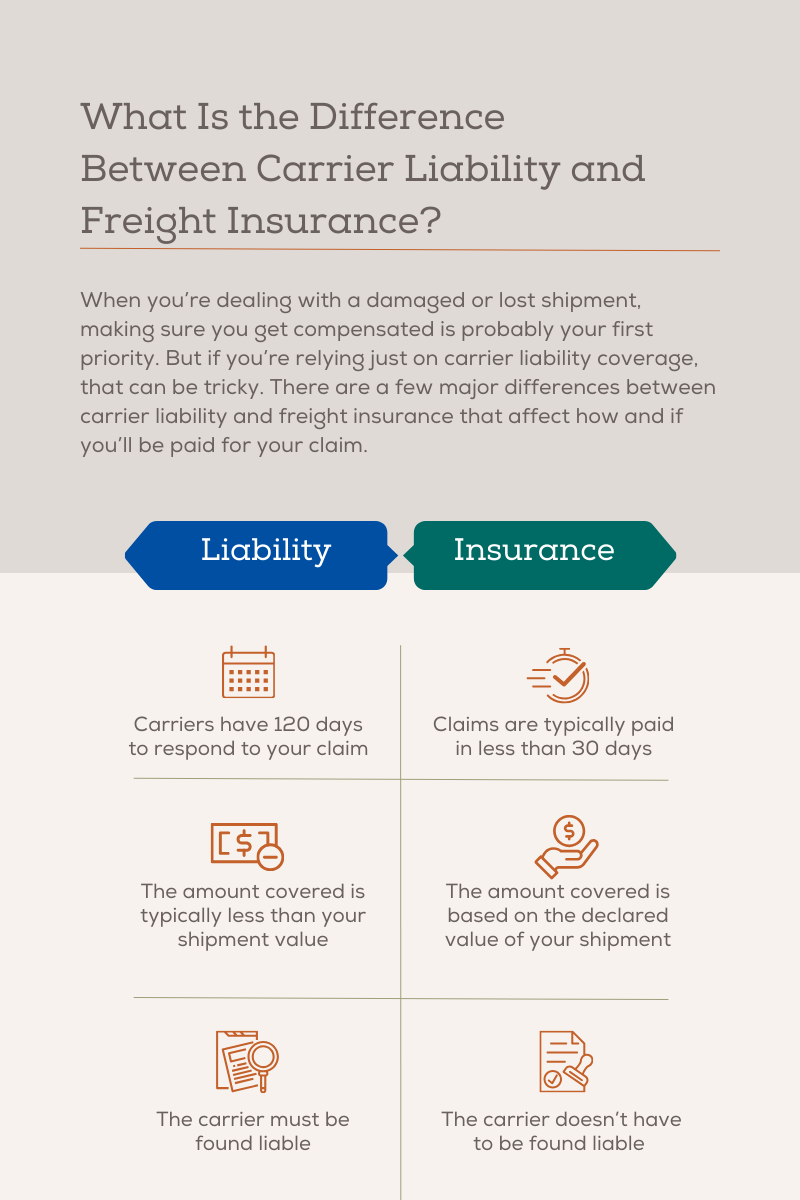
If your freight is only covered by carrier liability coverage:
- Your claim must be filed within 9 months of delivery
- The delivery receipt must include notice of damage
- Proof of value and proof of loss is required
- The carrier has 30 days to acknowledge your claim and must respond within 120 days
- Carrier negligence must be proven
If your shipment is covered by freight insurance:
- Proof of value and proof of loss is required
- Claims are typically paid within 30 days
- You are not required to prove carrier negligence
Deciding which option is best for your shipment
Anything that comes at an added cost needs to be evaluated critically and freight insurance is no different. There are a few things to consider as you weigh the potential cost and risk of damage and loss versus the cost and benefit of insurance. You'll need to think about the commodities you're shipping, how time critical your shipment is, and if you'd be able to weather the financial burden that comes with a denied or delayed claim payout.
Understanding your carrier's liability coverage and knowing the ins and outs of freight insurance can be tricky. If you have questions like “how much does freight insurance cost?” or “what does freight insurance cover?” the team at PartnerShip can help.